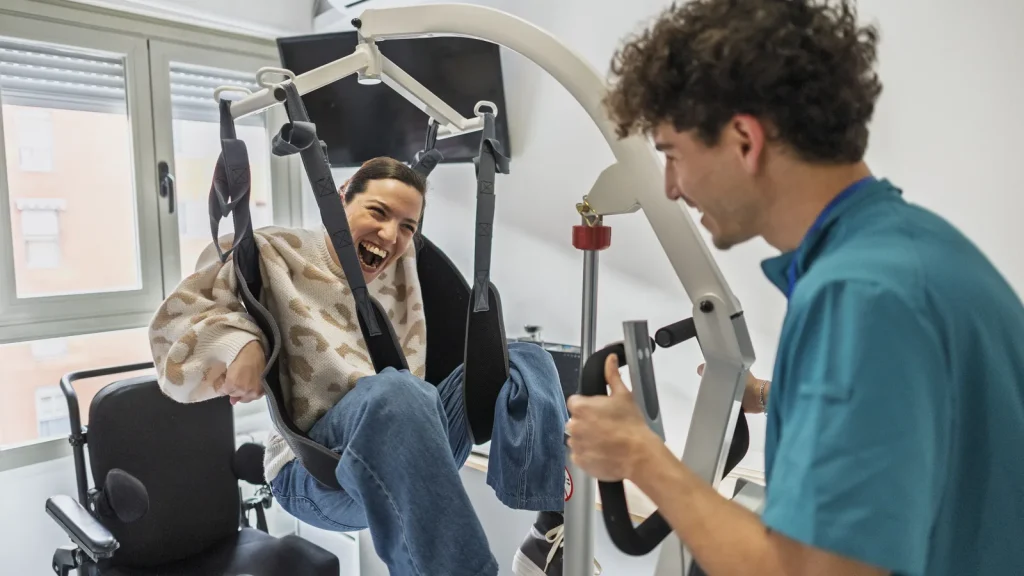
Patient hoists: when are they needed at home and what to look out for
A patient hoist is a mobility aid for individuals who cannot stand or be transferred safely with the help of a carer alone. It is typically used for transfers from the bed to a wheelchair, armchair, bath chair, or other care point. Its purpose is not to make the patient independent, but to facilitate a safer transfer when manual lifting is difficult or hazardous.
At home, a hoist may be needed when the patient has significant weakness, paralysis, severe instability, increased weight relative to the carer's capability, intense pain, or very limited cooperation during movement. It can also be useful when transfers are carried out multiple times a day and the family struggles physically to cope.
Using a hoist should not be done without preparation. It requires selecting the correct type of hoist, an appropriate sling, checking the user's weight, ensuring sufficient space around the bed, and training the people who will operate it. The wrong sling, poor fit, or rushed transfer can increase the risk of falls, injury, or discomfort for the patient.
Before a hoist is introduced to the home, it is useful to evaluate the space. Does the base fit under or around the bed? Is there sufficient width in the doorways? Is the floor stable? Can the transfer be performed without obstacles? If the patient uses a wheelchair, it must be considered whether its height and position allow for a safe transfer.
Equally important is the patient's condition. A patient who is very anxious, in severe pain, or unable to follow simple instructions may require a different approach or additional help. In any case, the family must seek guidance from a healthcare professional or a supplier who knows the equipment.
A hoist does not eliminate the need for human care. Before each use, the sling, stitching, clips, battery or mechanism, wheelchair brakes, and patient position must be inspected. The transfer must be done slowly, with explanations to the patient and without sudden movements.
For some families, renting can be a practical option when the need is temporary, such as after hospitalisation or surgery. For others, purchasing may make sense when the mobility difficulty is long-term. The decision must be based on the duration of the need, the weight and dimensions of the patient, the home space, and who will operate the equipment.
Before a hoist is used, it must be verified that there is sufficient space around the bed and the transfer areas. It also requires a sling suitable for the patient's body and weight, proper fit, and carer training. Operation without guidance can cause fear, poor posture, or risk of injury. A hoist should not be treated as a solution for every movement, but as a tool when manual transfer is difficult or hazardous. In some cases, temporary rental helps the family cover a recovery period or increased need, always with an emphasis on safety and proper use.
The decision can be made more soundly when the patient, space, and carer's capabilities are evaluated together. If a transfer requires excessive force or causes fear in the patient, the family is advised to seek guidance before proceeding in the same way.